
When you hear “OpenAI AMD deal,” you might think it’s just another tech headline. But this is more than that — it’s a deal that might reshape how AI computing works, influence stock markets, and push the entire chip industry forward. In this blog we’ll explore the OpenAI AMD deal in simple, clear language so you really understand what’s happening, why it matters, and what to watch next.
What Is the OpenAI AMD Deal?
The OpenAI AMD deal refers to a recent agreement between OpenAI (the company behind ChatGPT) and AMD (Advanced Micro Devices, a major chipmaker). Under this deal:
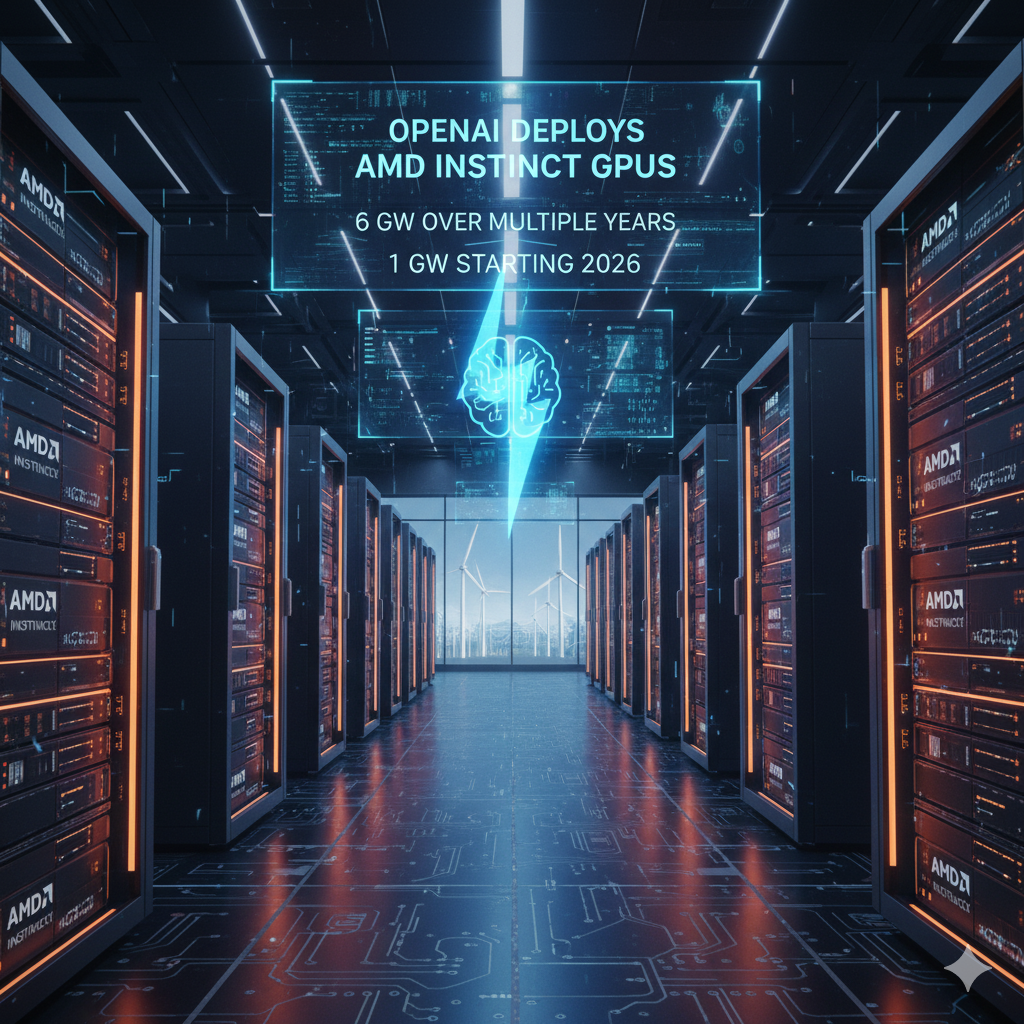
OpenAI would deploy up to 6 gigawatts of AMD’s Instinct GPUs over multiple years — starting with 1 gigawatt in 2026.
AMD will grant OpenAI a warrant for up to 160 million shares, with vesting tied to deployment milestones and share price targets.
The deal may result in OpenAI acquiring up to 10% stake in AMD.
Because the deal binds big hardware deployment with equity incentives, markets reacted strongly — AMD’s stock jumped about 23 % on the news.
Why the OpenAI AMD Deal Matters
Let’s break down the importance of this deal in everyday language:
Massive hardware commitment. A gigawatt of GPUs is no small thing. By promising this scale, OpenAI is betting heavily on AMD’s architecture to handle its future AI workloads.
Alignment of interests. With shares and warrants in play, both companies’ successes become linked. If AMD’s stock rises, OpenAI gains; if OpenAI uses more AMD GPUs, AMD gains revenue.
Competitive pressure. This puts competitive pressure on rival chipmakers like NVIDIA and Intel to innovate faster and possibly lower costs.
Signaling trust in AMD. OpenAI’s commitment is a strong vote of confidence in AMD’s tech, which could attract more AI firms to use AMD hardware.
Stock market impact. The 23 % surge in AMD’s stock shows how investors view this as a high-stakes, high-reward move. It could fuel more volatility in tech stocks.
Long-term strategic shift. Over time, such deals may reshape how AI companies structure hardware partnerships — moving from one-time purchases to multi-year, equity-tied contracts.
Ecosystem ripple effects. Downstream, component suppliers, cloud providers, and software partners might feel shifts as AMD scales up.
How Will This Play Out? (Risks & Rewards)
No deal is without risk. Here are some important potential upsides and challenges of the OpenAI AMD deal.
Rewards (Upside)
Lower cost of scale. If AMD’s GPUs perform well, OpenAI might gain cheaper, more efficient compute compared to relying on third-party hardware.
Exclusive access. OpenAI may get priority access to the latest AMD innovations, giving it a competitive edge.
Value creation. If AMD grows thanks to this deal, the stake and shares become valuable assets for OpenAI.
Influence on innovation. With close ties, OpenAI could influence AMD’s roadmap, pushing for features beneficial to AI workloads.
Risks (Challenges)
Technical integration. Scaling to gigawatts of GPU infrastructure is hard. Delays or performance problems could derail parts of the plan.
Market fluctuations. AMD’s stock could falter, hurting OpenAI’s stake value.
Competitor reactions. NVIDIA or other rivals could launch counter-offers, new products, or price cuts.
Regulatory scrutiny. A tie between a powerful AI firm and a chipmaker may attract regulatory attention, especially given the growing debate over AI power concentration.
Execution risk. Milestones tied to deployment and pricing are tough to hit reliably over many years.
Timeline & Key Milestones in the OpenAI AMD Deal
Here’s how the deal may unfold over the next few years:
| Period | Key Action | Importance |
|---|---|---|
| 2025–early 2026 | Planning, hardware design, preparation | Laying groundwork for installations |
| Second half 2026 | First 1 GW deployment of AMD Instinct GPUs | The first big test of the deal in action |
| 2027–2029 | Further phased deployments up to full 6 GW | Scaling the infrastructure |
| Based on share & deployment milestones | Warrant vesting and equity transfers | Linking performance to value creation |
| Ongoing | Performance reviews, adjustments, competition | Staying agile and responsive |
As deployment proceeds, each milestone matters — both for AMD and OpenAI.
Impact on AMD Stock (and Investor Sentiment)
The stock market’s reaction was swift and strong. After the announcement, AMD shares soared around 23 % in one day. That kind of move reflects investor optimism that the deal unlocks value.
But it also raises expectations. Investors will watch carefully:
Does AMD deliver on GPU performance and stable supply?
Will OpenAI actually ramp up deployment as promised?
How will AMD’s broader business (PCs, servers, consoles) be affected?
For existing shareholders, this deal could be a windfall — if all goes well. For new investors, it’s a bet on AMD’s AI future.
How This Affects the Broader AI & Chip Industry
The OpenAI AMD deal is not just about two companies — it touches many areas:
Chipmakers will compete harder to get AI deals.
Cloud providers may negotiate harder pricing or form tighter alliances.
AI startups might lean toward AMD infrastructure if costs drop or if OpenAI’s path proves successful.
Software stacks (like frameworks, libraries) may tune more for AMD architectures.
Geopolitics and regulation may take notice, as AI infrastructure becomes more concentrated.
If this deal is successful, it could encourage more vertical integration: AI companies working deeply with hardware manufacturers rather than buying off-the-shelf.
What Should Readers (Investors, AI Enthusiasts) Watch Next?
Here are some signals to track:
AMD’s quarterly results. Are revenues and margins improving in their data center or GPU segments?
Deployment updates. How many gigawatts of AMD GPU capacity has OpenAI installed?
Warrant / equity issuance. When and how many shares get transferred?
Competitor responses. Does NVIDIA or Intel cut prices or announce new AI chips?
Performance benchmarks. How do AMD GPU clusters compare in AI tasks (throughput, power efficiency)?
Regulatory developments. Any antitrust reviews or government scrutiny?
Partnerships & contracts. Are more AI firms signing with AMD?
By watching these, you can see if the OpenAI AMD deal is delivering or facing headwinds.
Your Takeaway
At heart, the OpenAI AMD deal is bold. It ties AI’s future directly to hardware scale, aligns incentives between software and silicon, and shakes up how AI firms might build infrastructure in years to come. If all goes right, it could be a defining moment in AI history. If not, it might be a cautionary tale of overreach.
If you’re interested in deeper analyses of AMD’s financials or AI infrastructure trends, check out our posts on AMD Financial Analysis and AI Infrastructure Trends.